
1. Introduction
A bank is an important financial institution that plays a key role in the economy. Its main function is to accept money deposits from people and keep those funds safe while providing interest on savings. Banks also use a portion of these deposits to provide loans, such as home loans, car loans, and business loans, to individuals and companies. The difference between the interest earned on loans and the interest paid on deposits is one of the bank’s main sources of income.
In addition to traditional banking services, modern banks also offer services like wealth management, digital payments, mutual funds, insurance, and foreign exchange. By managing the flow of money and credit in the economy, banks support business growth, encourage investments, and help people achieve financial stability and security.
2. Employment Opportunity
The banking sector is one of the largest employment generators in India, offering a highly structured career path with immense stability and growth potential. Job vacancies are abundant across multiple tiers:
- District Level: Every district requires a vast network of rural and semi-urban branches. Job vacancies here typically include Clerks, Probationary Officers (POs), and Customer Support staff who handle day-to-day retail banking, account management, and agricultural loans.
- State Level: At the regional or state headquarters, job vacancies expand into middle management. These roles focus on regional sales strategies, corporate banking, auditing, and specialized operations.
- National Level: Corporate head offices offer top-tier job vacancies in risk management, investment banking, treasury, and strategic planning.
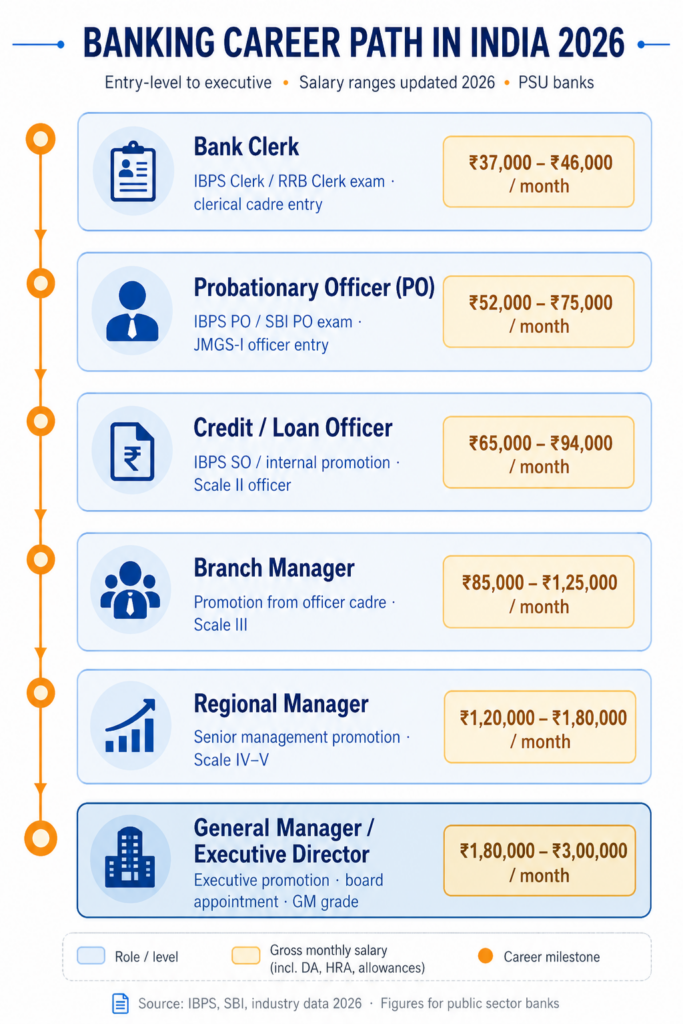
Career progression in this sector is highly systematic. An individual starting at an entry-level position can climb the corporate ladder through internal promotions to become a Branch Manager, Regional Head, and eventually reach top-level management (e.g., General Manager or Vice President) within public or private sector banks.
3. Various Posts & Salary Range
Job vacancies in banking offer a clear progression path from grassroots operations to national leadership. Based on current 2026 Indian market trends, here is the hierarchy and estimated annual compensation:
- Grassroots / Entry Level: Customer Support Officer / Bank Clerk
Handles daily transactions, account openings, and basic customer queries at the local branch.
- Salary Range: ₹3.0 Lakhs – ₹5.0 Lakhs per annum.
- District / Branch Level: Branch Manager
Leads the entire local branch, ensuring profitability, regulatory compliance, and optimal customer satisfaction within the district.
- Salary Range: ₹9.0 Lakhs – ₹18.0 Lakhs per annum.
- State / Regional Level: Zonal Manager
Oversees the performance of dozens of branches across a state or region, driving revenue growth and managing larger corporate client portfolios.
- Salary Range: ₹18.0 Lakhs – ₹30.0 Lakhs per annum.
- National / Corporate Level: Vice President
Operates from the national headquarters, making macro-level decisions on bank policy, high-level risk management, and multi-million dollar investments.
- Salary Range: ₹40.0 Lakhs – ₹1.5 Crores+ per annum.
4. Eligibility
Securing a job vacancy in the banking sector requires a mix of formal education and specific skill sets.
- Qualifications: A Bachelor’s degree in any discipline (B.A., B.Sc., B.Com) from a recognized university is the minimum requirement for most entry-level officer roles. Specialized roles (like IT, HR, or Forex) may require a B.Tech, MBA, or CA qualification. Public sector bank job vacancies strictly require clearing competitive exams like IBPS, SBI PO, or RBI Grade B.
- Skills Required:
- Hard Skills: Financial literacy, basic accounting, proficiency in banking software (such as Finacle), and data analysis.
Soft Skills: Excellent verbal and written communication, strong interpersonal skills, problem-solving abilities, and a high degree of ethical integrity and attention to detail.